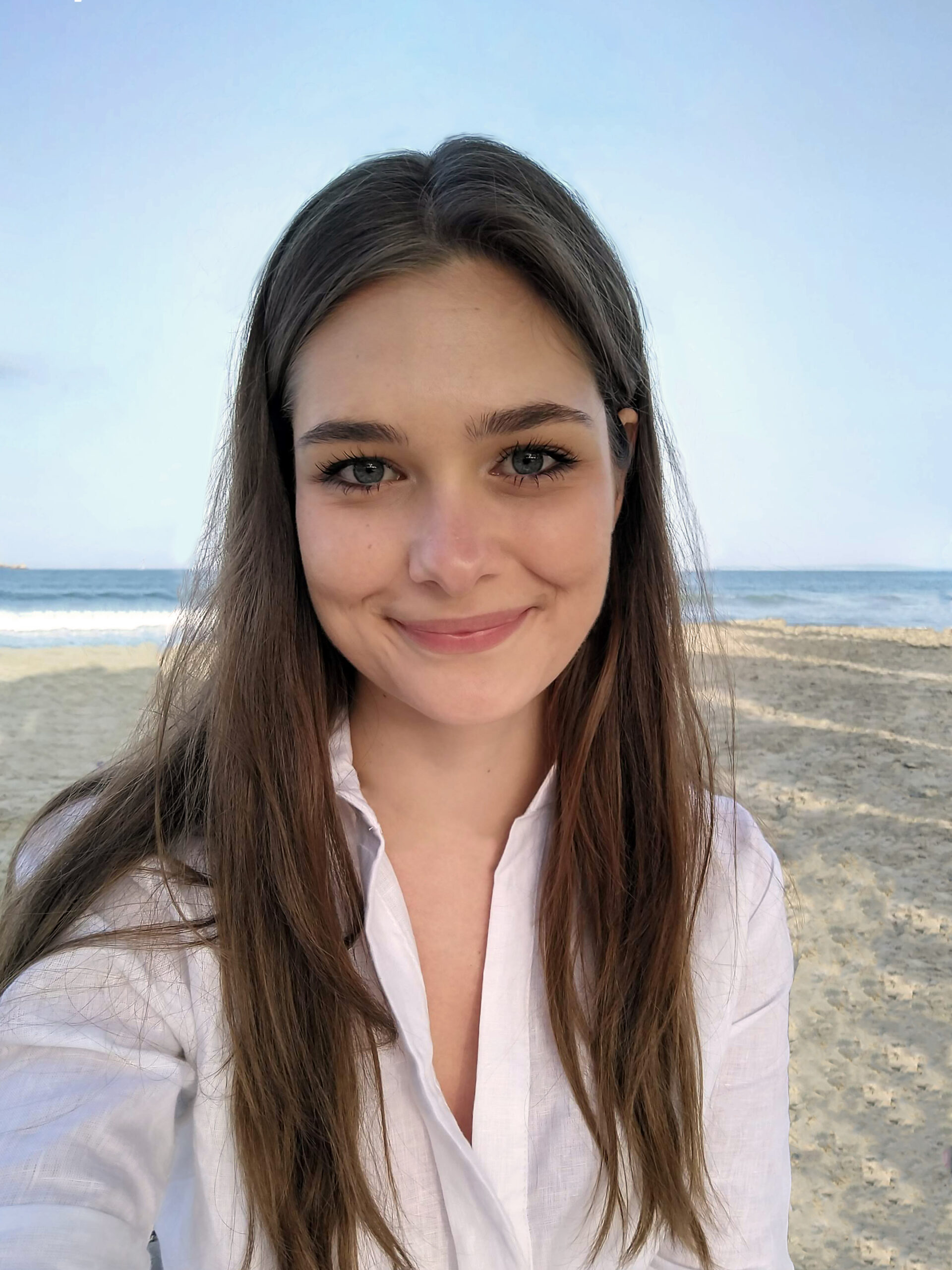
A year at Sigma Growth Specialists: meet our Brand and Communication Associate, Julia Radonjić, as she looks back on her first year with us in a one-on-one interview.
One Year In: A Conversation With Julia Radonjić
Julia Radonjic joined Sigma Growth Specialists as an intern on August 2, 2025, and became our Brand and Communication Associate four months later. In that year, she rebuilt our brand identity from scratch, helped to interview and train the interns who came after her, and built the system we now use to make our content. We asked her to look back on it.
Where were you in your life when you applied?
“I graduated in Product Design and Visual Communication from the Università Iuav di Venezia in September 2023, and I spent the next two years as a freelancing designer traveling the world. I lived in Madrid, then Paris, then Singapore, and from Singapore I traveled through China, Japan, Korea, Indonesia and Malaysia. Along the way, I took a brand management course with London Business School and then joined an INSEAD study trip on innovation in China. I wanted to understand how business works in markets other than the one I grew up in.
“By the summer of 2025, I was back in Milan, my hometown. I had already been working as Brand Manager at my family’s firm, Ulis, for a year. The firm has been SWAROVSKI’s partner in Montenegro since 2002. Over that year, I had learned to work efficiently enough to finish my workday by early afternoon, so I started looking for a part-time remote role that would challenge me.”
Why a small company?
“I wanted to work directly with the founder, because I wanted to improve my own decision making and leadership. A small company asks more of you than a large studio does. I found Sigma Growth Specialists on LinkedIn, and I was drawn in by the logo. A few months later, I ended up redesigning it myself.
“The time difference didn’t worry me at all. I had already worked from Singapore with my Austrian, Greek and Montenegrin managers at Swarovski.”
What was the interview like?
“I was asked to make a social media post using artificial intelligence, and I was given a couple of hours. I took forty minutes, because I wanted to show that I could make something worth reading in under an hour and spend the rest of my day on strategy. It was one of my first times using artificial intelligence, and that was part of the challenge. I wanted to show that a designer with a traditional training could also be open to new tools.
“Interviewing me were our founder, Ronak Patel, MBA, and our Chief of Staff at the time, Goffredo Orlandi Contucci, and they cared less about the post than about how I had made it and why, which surprised me. Asking ‘why’ is a very design-minded question. When you answer it, you also end up asking ‘why not?’, ‘what else?’ and ‘how?’, and that is how a process gets better. They were serious and professional, and they still let me crack a few jokes. I knew straight away that we were a good fit.”
What were your first weeks like?
“I was told to study. For a while, I listened in on meetings and took notes, and then I researched everything in those notes so that I arrived at the next meeting prepared. The interns at the time were researching businesses to approach, so I learned about buying and selling, market analysis and cold calling before doing any of it myself. I desperately wanted to contribute, as I always do, and that period taught me a lot.
“From the first day, I was encouraged to give the other interns feedback on their presentations. It was honest, peer-to-peer feedback, and it was very different from the compliment-coated feedback I was used to in corporate settings. I found it refreshing to give and to receive.
“In my second week, I was asked to redesign the website. I had only done that officially for a client once before, with a programmer beside me, and this time we were on our own. I had to learn Figma instead of my usual design tools, and that led to months of work on the whole brand: colors, typography, imagery, tone of voice, graphic elements and the logo.”
What did the old brand get wrong?
“The concept was good from the start, but the execution lacked detail and forethought. The logo looked strong, but it didn’t work at small sizes and wasn’t easy to recognize on screens. We needed a mark that was original and instantly recognizable, and it didn’t have to look obviously like a sigma symbol.
“Ronak didn’t need persuading that branding mattered. What I explained was that a brand identity has to be studied and then applied to everything the company produces. It helps to give a brand a personality: the colors it wears, the fonts it writes with and the voice it uses with customers and peers. A single client might receive emails and business cards from a dozen companies, and you want yours to be the one they recognize immediately.”
Where did the two of you disagree?
“Ronak pushed back on my choice of a serif font for our titles, paired with a sans serif for everything else. I explained that a serif recalls the classic consulting firms and appeals to an older audience, while the pairing still looks modern and clean to a younger one. That convinced him, and the serif stayed.
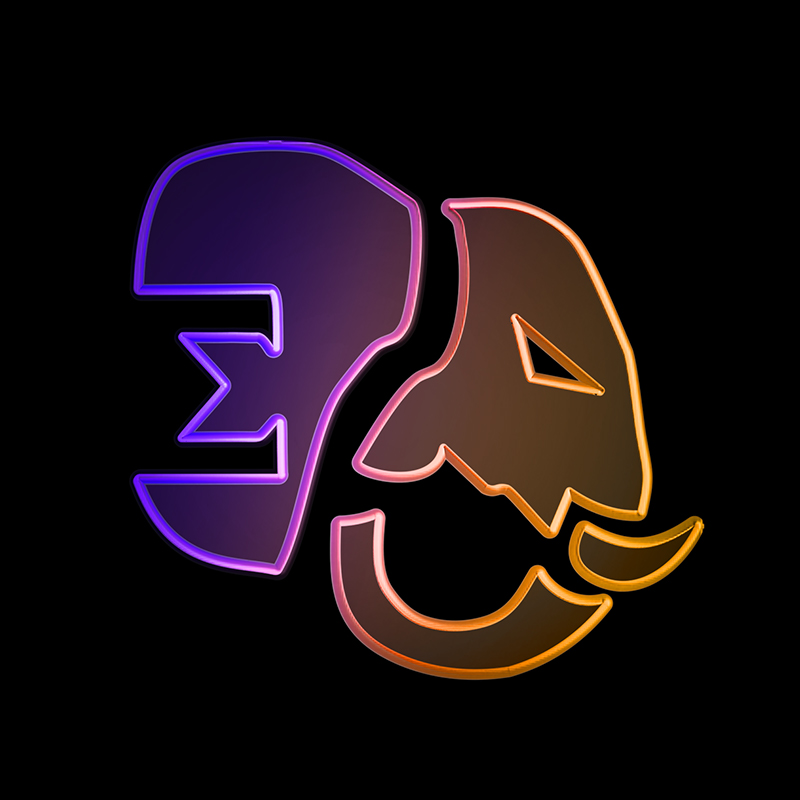
“On color, the pushback came from me. Ronak wanted purple and yellow as the main colors alongside black, just as in the original logo. I worried that such a high-contrast scheme could look sporty and less serious, so I offered him many other palettes, and he chose purple and yellow every time. There was a reason for that: dark purple and yellow were the colors of his beloved college football team – the personal ties to our design choices don’t stop there, though! The elephant, for example, is a symbol of wisdom and strength, while also paying tribute to Ronak’s Indian heritage. To honor the meaning behind the logo, I designed a gradient that moves between the purples and the yellows through orange and pink tones, which made them look far more elegant while keeping them modern, and redesigned the whole logo to be more elephant and less sigma – showing a sigma symbol within the elephant, instead. There is a lot of Ronak – his heart, his passion, his curiosity – in this business, and I wanted the brand to show it.”
How did you go from intern to associate?
“As my four-month internship came to an end, I decided I wanted to fight to stay. I wrote down everything I had contributed and asked Ronak for a meeting. I explained that I had built the brand identity from scratch, and that it would keep earning for the company for as long as the company existed. I also offered to stay on for marketing strategy, onboarding, training and creating the guides and tools we use to attract new clients. I wanted to make sure Ronak knew that the weight of growing the business wouldn’t have to fall on him alone. He agreed, and here I am!”
What changed once you stayed?
“My branding work moved from building the identity to applying it across LinkedIn, Facebook, Instagram, X and YouTube. The biggest change was my work with artificial intelligence. I went through several rounds of training on how to use Claude and how to give it clear instructions, and I built a system that produces content in our brand style in a fraction of the time it would take me by hand. That meant training Claude, building reusable skills and writing standard operating procedures for my own job. It’s still a work in progress, and I expect it to improve a great deal.”
How does it feel to automate part of your own job?
“It makes me very happy, because making content was never part of my dream. The system frees up my time for strategy, which is the work I care about most. I don’t learn a skill so that I can do it forever – I like switching things up, which is why I don’t feel competitive toward artificial intelligence. It can do what I do? Great – gives me time to learn something new!”
What is the dream, then?
“At work, it’s finding the right strategy to bring in clients who are a good fit for us, so that we can help different businesses reach their goals and grow sustainably. For myself, it’s learning the skills to build brand identities that work well and stand out in a world chock-full of companies.”
You now help to hire interns yourself. What do you look for?
“I started co-conducting interviews with Ronak in December 2025. He trusted me to have the firm’s interests at heart, and I had hiring experience from my work with Swarovski’s partner, Ulis. The month before, I had built a training program for our operations interns using NotebookLM, so I already knew what we needed from them.
“My advice to any intern is to put learning at the center of everything. Study, stay curious, and develop your ideas freely before you present them. Be independent in how you learn, and above all be proactive.”
What have you learned from working so closely with Ronak?
“I used to be a strict perfectionist. I’ve always worked fast and held myself to a very high standard, but I would keep working on something for as long as it took to make it perfect. Ronak taught me to put doing ahead of perfecting: draft it first, release it, see how it does and then review it. You never know whether you’ll scrap a piece of work entirely, and you can always perfect it later.
“The job posts I write for interns are a good example. I write a broad first version that covers everything, and then Ronak narrows it down and edits it to his liking. It works better, and it saves me a lot of time.”
How do the two of you work differently?
“Ronak is the people person and the personality of the company, while remaining just as focused on sales and numbers. I would describe the way I work as very linear: I see a goal and take steps toward it, stepping back or sideways when I need to. Ronak works in a web, jumping from one topic to another in every direction. He sees countless opportunities and threats at once, and twice as many ways to respond to them. Because he is so curious, proactive and experimental, I think it helps that I can be a little more grounded.”
And what do you want from your second year?
“A better balance between work and the rest of my life, which is something every young person has to learn. I also want to be better organized, and to spend less time on creating content for social media and more on design and strategy. I know I can find that here, because Sigma Growth Specialists helps its team grow as well as its clients. The company grows because of the people in it, and we grow alongside it. It’s fertile ground for learning, curiosity and creativity.”